Lagario 3: Órbita · Comparison
Agar.io with gravity? Meet Lagario 3
Yes, there is one. Lagario 3 keeps the formula agar.io made famous: eat what's smaller, run from what's bigger, split to hunt, eject mass. Then it puts you in a universe with real gravity, where your planet carries momentum, stars pull and burn, and rivals your size crash into you instead of sliding past. It's free, multiplayer and runs in your browser.
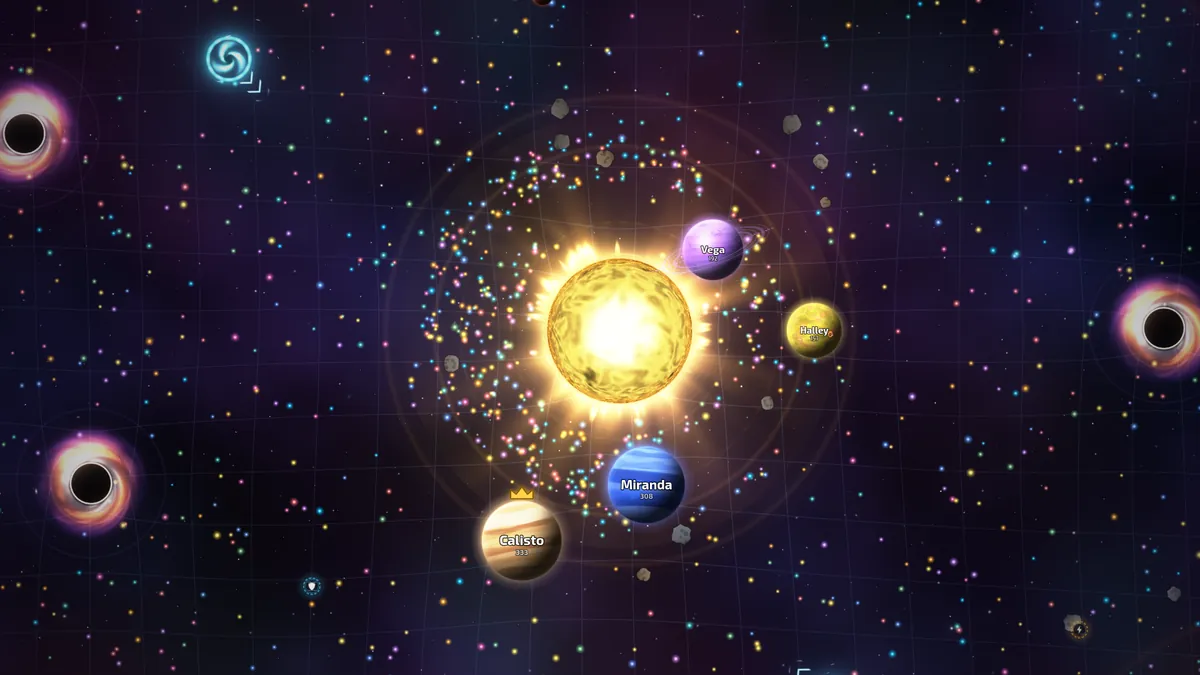
Side by side: the classic formula and Lagario 3
Agar.io, released in 2015 by Brazilian developer Matheus Valadares, turned “eat or be eaten” into a genre. The middle column below is its classic rule set as most players know it; details have changed over the years. The right column is Lagario 3 in Orbit, its default mode, or in any mode with the Orbit physics modifier. Lagario is an independent game and is not affiliated with agar.io.
| Mechanic | Agar.io (classic) | Lagario 3 (Orbit) |
|---|---|---|
| Moving | Your cell heads for the cursor and slows down as it grows. | Momentum: your planet swings round gradually and drifts. It slows as it grows, but a slingshot past a star flings it out at up to about 3× its top speed. |
| Growing | Eat pellets. | Eat stardust and asteroids. About a third of the stardust sits in rings around the stars. |
| Eating others | Swallow a cell once you're about 25% bigger. | The same: swallow planets you outweigh by at least 25%. |
| Same size | Cells that can't eat each other pass over each other. | They collide and bounce. A hard hit knocks off up to 25% of a planet's mass as chunks anyone can eat. |
| Split | Space shoots half your cell forward; the pieces merge later. | The same, on Space. Your halves feel gravity too. |
| Eject mass | W throws out a bit of mass to feed a teammate or a virus. | W or E feeds teammates and black holes, and pushes your planet the other way, like a rocket. |
| Viruses | A cell big enough to eat one bursts into pieces. Small cells hide under them. Feed one to shoot a new one. | Black holes do that job: they shred planets bigger than them, small planets hide inside, and 7 ejections fire a new one. |
| Gravity | None. | Inverse-square pull from stars, black holes and planets of 150+ mass. A dotted line shows your path and turns red if it hits a star. |
| Hazards | Viruses. | Stars that burn, black holes, comets and wormholes. |
| Modes | Its list has changed over the years. | Orbit, Free for all, Collapse (battle royale), Teams and Gravity chaos, plus 8 room modifiers. |
| Multiplayer | Public game servers. | Peer-to-peer rooms: the creator's browser hosts, friends join by link or 5-character code. No account, up to 16 people, and bots top the room up (to 14 planets by default). |
The physics behind the right column, with every number, is in how gravity works in Lagario 3.
What a round feels like with gravity
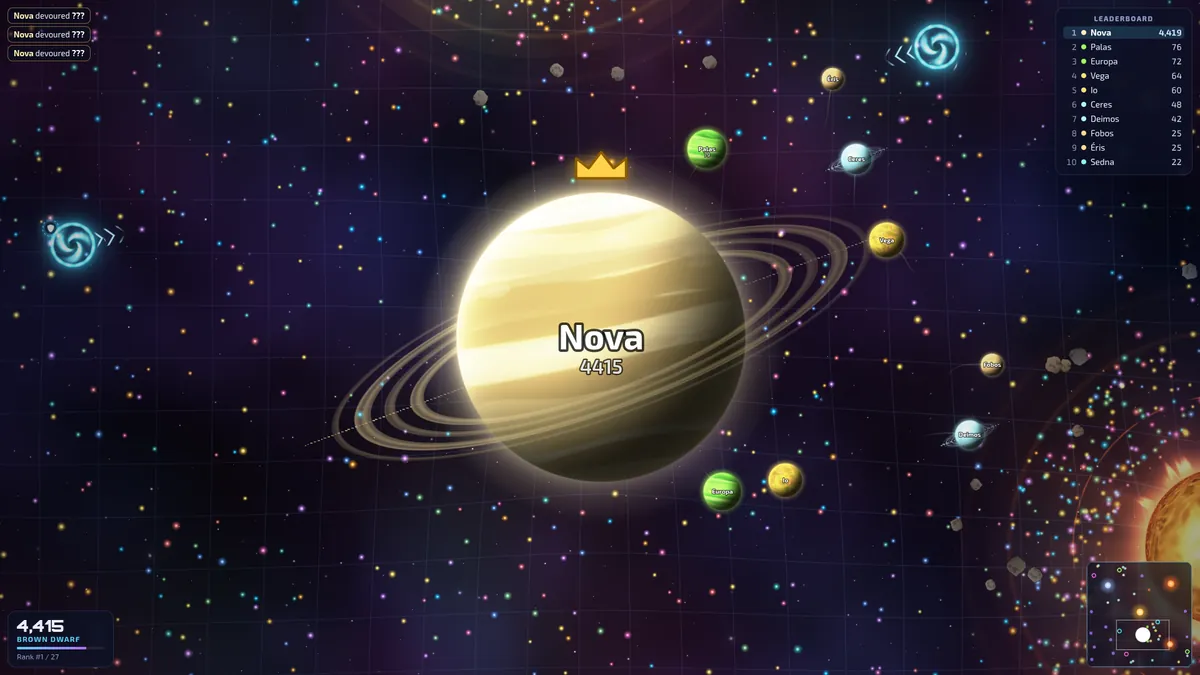
You spawn as a tiny planet. In agar.io you'd drift towards the nearest pellets; here the first thing you notice is the star. Its dust ring is the richest feeding ground on the map, so you learn to circle through it, aiming across the pull rather than into it. The dotted trajectory line is your safety rope: when it turns red, you're falling in.
Then comes your first slingshot. Dive close without touching, keep your aim along your motion, and you come out far faster than your top speed. The game tells you by how much: “Slingshot! 193% of top speed”. That burst runs down prey and escapes hunters.
Mid-game, the standoff changes. Two planets of similar size can't eat each other, so you ram. Hit hard and chunks fly off; the lighter planet takes the bigger jolt. Past 150 mass you start pulling other planets towards you, but you also turn later, so a giant plans every move early.
Stars stay dangerous all game: touch one and you burn, so point straight away to climb out.
Tips for agar.io veterans
These are for Orbit, the default mode, or any room with Orbit physics.
What transfers
- The 25% rule. Size up every planet you see, exactly as before.
- Split kills still work, and the pieces still merge back after a while.
- Black holes are your viruses: hide in them when small, avoid them when big.
- Bigger means slower, at least until a star gets involved.
What doesn't
- Straight-line chases. You can't turn on a dime: lead your target and start turns early.
- Hugging an obstacle. A star isn't cover. It burns.
- Waiting out a same-size rival. Ram it and eat the chunks.
- Ejecting only to feed. Every throw also pushes you backwards: use it to escape a star or bend a red trajectory.
- Splitting next to a star. Smaller pieces burn up faster.
- Feeling safe from giants. A big planet fresh out of a slingshot can still catch you.
New to the controls? Read how to play Lagario 3.
Pick how much gravity you want
Orbit
Everything on this page. The default mode.
Free for all
The classic, closest to agar.io: no stars, quicker steering, same-size planets overlap.
Collapse
Battle royale: the zone shrinks, nobody respawns, the last planet standing wins.
Teams
Mars × Neptune × Earth. Allies can't eat each other.
Gravity chaos
Strong gravity, more black holes and power-ups.
When you create a room, the Orbit physics modifier brings stars, momentum and collisions into any of them. Details in game modes and modifiers.
FAQ
Is there an agar.io-style game with gravity?
Yes. Lagario 3 is a free multiplayer browser game in the agar.io style, with momentum, orbits, slingshots, stars that burn and collisions between same-size planets.
Is Lagario related to agar.io?
No. Lagario is an independent game in the same genre, made by Thomas Reichmann, and is not affiliated with agar.io.
Same hunger, new physics. Free, in your browser.
Play now