Lagario 3 is an agar.io-style game with real gravity: a free multiplayer browser game where you grow a tiny planet
into a giant. Orbit stars, slingshot past them at up to about three times your top speed, crash into rivals and knock
chunks off them, or devour them whole. The current version, Lagario 3: Órbita, came out on
24 September 2026.
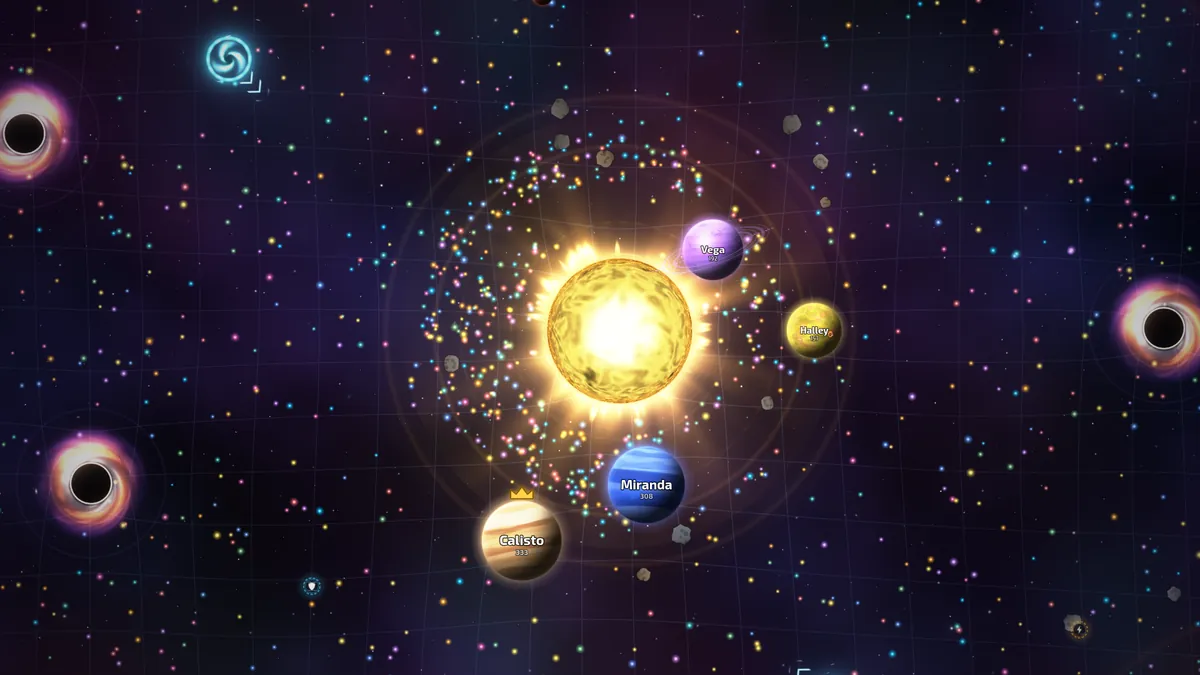
A star, its dust ring and the planets circling it.
What's different from other agar.io-style games
The core idea is the one you know: eat what's smaller, avoid what's bigger. Lagario 3 builds everything else around
real physics. For a side-by-side table, see agar.io with gravity: how Lagario 3 plays differently.
Real gravity: momentum, orbits, slingshots and a live trajectory line.
Stars that burn, dust belts and asteroids in orbit.
Collisions that knock off edible debris: in Orbit (or with the Orbit physics modifier), planets of the same size bounce off each other instead of one eating the other.
Ejecting mass works as thrust. If you've played Osmos, moving by throwing mass behind you will feel familiar.
5 modes, 8 modifiers and bots to keep rooms lively.
Multiplayer through a shared link: no download, no account, no game server (peer-to-peer).
29 planets (20 to unlock), 29 achievements, daily missions and levels.
Desktop and mobile, in English and Portuguese.
Play free-for-all in Orbit, or bring the physics into Collapse (a battle royale in a shrinking universe), Teams and
Gravity chaos. There are black holes, comets and wormholes too. The how-to-play guide
covers every mode, modifier and control.
Launch trailer
The Lagario 3: Órbita launch trailer (1:06): orbits, slingshots, collisions, black holes, comets, wormholes and the Collapse, Teams and Gravity chaos modes.
From a 2018 weekend blob game to Lagario 3: Órbita
2018: a weekend blob game
Lagario started as a weekend project: planeta.js, vector.js and a lot of will.
Lagario (version 1)
A planet with inertia and gravity, dust, asteroids, black holes, power-ups, 3 modes and bots, with peer-to-peer
multiplayer hosted in a player's browser, host migration, a room lobby with no game server, offline play as a
PWA, and English and Portuguese.
Lagario 2: Colapso
Added Collapse, a battle royale where the safe zone shrinks in stages, plus comets, wormholes, emotes, room
modifiers, levels, achievements, daily missions and new planets to unlock. It also brought a new WebGL2
graphics engine, a killcam replay and a 1-minute tutorial.
Lagario 3: Órbita
Rebuilt around real physics. Every planet carries momentum. Stars and big planets pull with inverse-square
gravity, and a dotted line shows where you're falling. Dive past a star to slingshot out, complete an orbit to
sweep up its dust belt, and get too close and you burn. In Orbit (or with the Orbit physics modifier), planets of the
same size collide instead of eating each other, and ejecting mass works as thrust. Your Lagario 2 profile carries over.
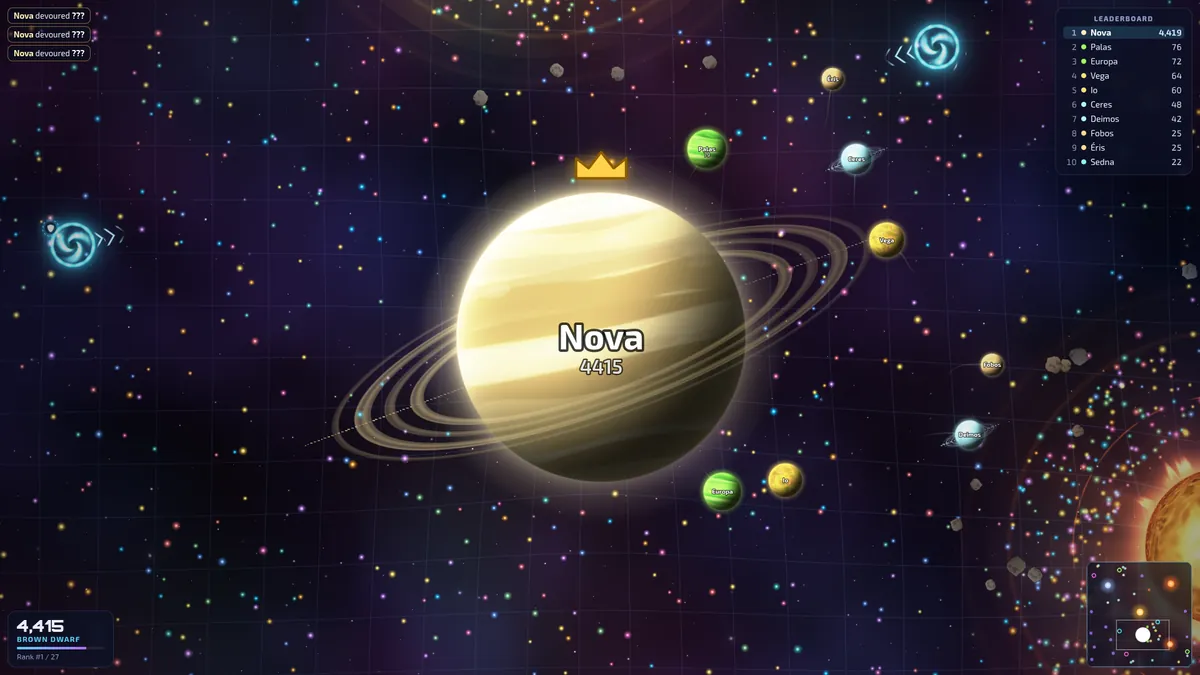
Grow big enough and you start pulling the small ones in.
Whoever creates a room hosts the match: their browser runs the simulation in a Web Worker, and the other players
connect straight to it over WebRTC, with Nostr relays helping them find each other. If the host leaves, another
player takes over the room automatically and the match goes on. The site is static apart from a small optional
function that hands out TURN relay credentials.
Play with friends by link: the Invite button copies a link to your room, or friends can type its 5-character code.
Up to 16 people per room (12 by default). Bots top the room up to 14 planets by default, and the room's creator can set that from 0 (no bots) to 30.
Public or private rooms, and a list of public rooms to join.
Free, no ads, no account, installable
Free, with no ads. No account either: pick a name and play.
In the browser, on desktop or mobile, with mouse and keyboard or touch controls.
Installable as an app (PWA) from your browser, on a computer or a phone.
English and Portuguese (Brazil). The game follows your browser's language, and you can switch it in Settings.
Graphics: WebGL, with a Classic (Canvas 2D) renderer as an option and fallback.
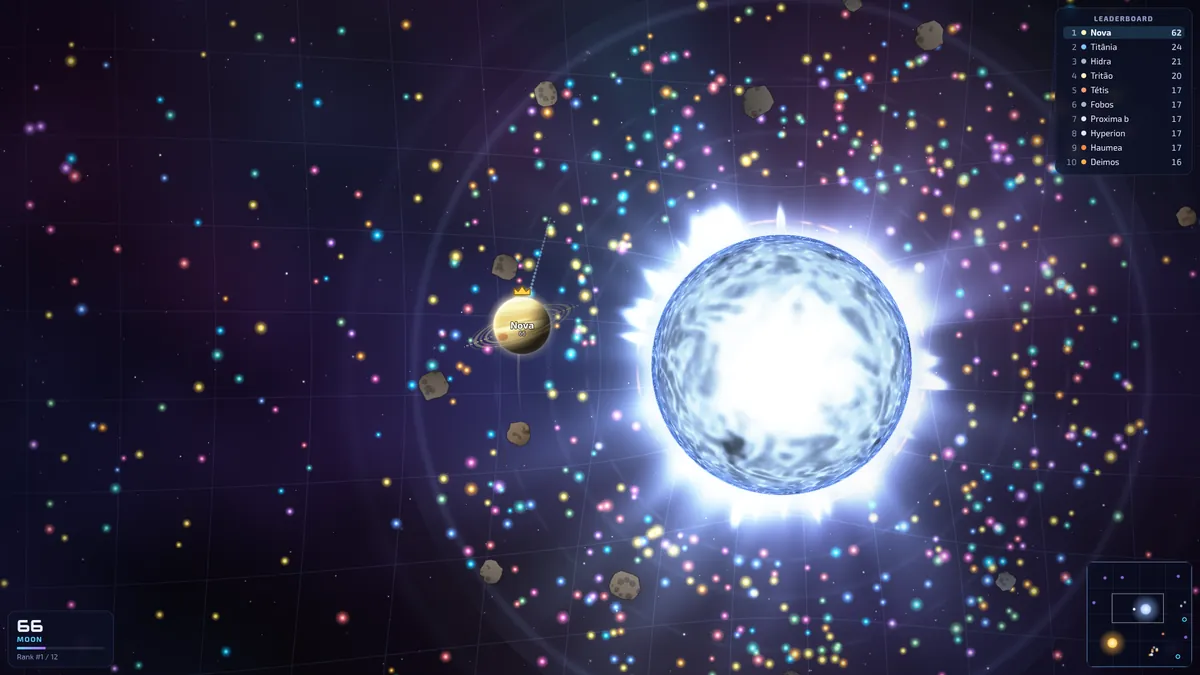
Orbiting a blue star.
Who made it
Lagario is made by Thomas Reichmann, an independent developer from Brazil, in TypeScript and WebGL.
It's an independent game in the agar.io genre and is not affiliated with agar.io.
FAQ
Is Lagario 3 free? Are there ads?
It's free, with no ads.
Do I need to download it or sign up?
Neither. Lagario 3 runs in the browser on desktop and mobile, and there's no account: pick a name and press Play. Your level, achievements and unlocked planets are saved in your browser.
How many players fit in a room?
Up to 16 people (12 by default). Bots keep the room lively: by default they top it up to 14 planets, and whoever creates the room can pick anywhere from 0 to 30.
How does multiplayer work without a game server?
The player who creates a room hosts the match in their own browser, and the others connect to them peer-to-peer over WebRTC. Nostr relays only help the players find each other. If the host leaves, another player takes over the room.
Is Lagario related to agar.io?
No. Lagario is an independent game in the same genre, made by Thomas Reichmann, and is not affiliated with agar.io.
How do I play with friends?
Create a room, open the in-game menu and press Invite to copy the room link, then send it to your friends. They can also join with the 5-character room code.
Can I play on my phone?
Yes. On a touch screen you drag on the left side of the screen to steer, and use the SPLIT and EJECT buttons on the right.
Can I install it as an app?
Yes. Lagario 3 is a PWA, so your browser can install it on your computer or phone like an app.